

Rabbit Holes 🕳️ #97
From civilizational anxiety to quantitative validation, life as an echo of the masses & machines, transformational adaptation, the positive BANI and Nagi's baby boom

THIS WEEK ↓
🖼️ Framings: Civilizational Anxiety // Quantitative Validation // Life As An Echo Of The Masses & Machines
🌀 Re-Framings: Slow Down & Go Long // Happiness Joy // Transformational Adaptation
🧬 Frameworks: The Positive BANI
🎨 Works: Gamer in Residence // Nagi Babyboom Town

Reading Time: 7 Minutes
🖼️ Framings
Naming Framing it! To crystallize something we feel but rarely put a name to.
😨 Civilizational Anxiety
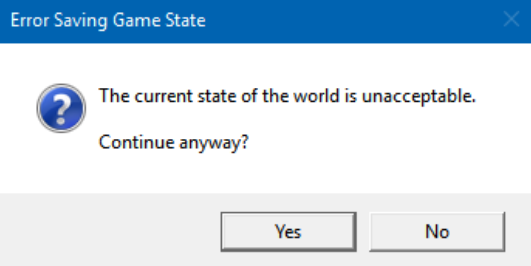
Umair Haque claims that a new universal feeling is emerging, felt both by the left and the right side of the political spectrum. We’d be wise to let it unite us rather than divide us, which is what’s been mainly happening.
“Think about the many new feelings we’re beginning to experience. We often discuss how even our vocabulary for naming them, let alone our paradigms for understanding them, are barely emergent. Eco-grief, the rage and despair produced by stagnation, the sense of abandonment and betrayal so many feel around leaders and institutions, the strange sense of hollowness that this is how the future turned out.
Civilizational anxiety is an umbrella for all of those new emotions. […]
It’s everywhere these days, if you look. Think of our vernacular, to describe an average day. We wake up and “doomscroll.” Off we go, to our “bullshit jobs.” We’re glued to our screens, where macro and micro demagogues scream and rage. We check the news, and sort of expect a deluge of pretty horrifying stuff to hit us.
And that’s all hard.
We’re enveloped in civilizational anxiety these days. We may feel it in different ways, but, as we’re about to explore, the strange thing is that it’s universal. […]
It unifies us, though we often let it divide us instead.”
» (What to Do With Your) Civilizational Anxiety by Umair Haque
📊 Quantitative Validation
Eye-opening article and framing that explores the deeper implications of our increasingly quantified and gamified lives.
“As qualitative validation all but erodes, the only form of validation left is quantitative. Miles run. Books read. Movies watched. Songs streamed. Beers bought. Fantasy wins. We have turned competition into connection because it’s the only way we’ve learned that we can get attention — and when you see a continuous decline in relationships outside of your phone because spaces continue to disappear, you’ll cling to whatever you can to feel like you belong to a larger world. That’s without taking into account how the platforms themselves use gamifying tactics, preying on emotional and physical impulses and serotonin boosts, to ensure that the little device in our hands connecting us to those competitive blurry faced strangers, feels more important than trying to form quality connections elsewhere.
The problem with quantifying everything is that we can’t ever rest. Our end state is a growth state — a philosophy that defines corporate America boardrooms and shouldn’t inhabit our bedrooms or morning coffee. […]
Despite more than a decade of people lamenting this shift from personal spare time to commercialized ambition, we haven’t slowed down. We’ve doubled down and sped up. […]
Maybe I’m blaming too much on technology, but we used to read a book before bed and go to sleep thinking about the story floating behind our eyes. Now we think about how many chapters we need to read before we can log it in Goodreads and pick up the next book. That’s a symptom of soulless hyper connection.
This is what the fight for attention and who controls your attention really looks like.”
» Here's What the Fight For Your Attention Really Looks Like by Julia Alexander
📣 Life As An Echo Of The Masses & Machines
Very thought-provoking piece about how we’re “living in a world where decisions are fully governed by machines and the crowd” instead of our own choice, our own autonomy.
“Algorithms might make for comfortable consumers, but they cannot produce thoughtful creators, and they are slowly taking your ability to choose from you. You might think you’re choosing, but you never really are. When your ideas, interests, and even daily meals are largely inspired by whatever was already approved, already done, already voted on and liked, you’re only experiencing life as an echo of the masses (or the machines, if personalized based on historic preference). And in this echo chamber, genuine discovery is rare, even radical. […]
There’s a an unconscious allure in this conformity, a feeling of belonging, of social safety, it’s a warm blanket you aren’t alone in the cosmos. But at what cost? In blending into the mainstream wasteland, you risk losing something deeply human: your impulse to explore, the courage to confront the unfamiliar, the potential to define yourself on your own terms. You don’t get real creativity without courage, and no one has this until they stop looking to the crowd for consensus approval. […]
If you can begin to reclaim moments of curiosity and choice, I’m certain you’ll find yourself becoming more fully and uniquely you. And in those tiny rebellions, you’ll remember the thrill of what it means to exercise real autonomy.”
» Don't let machines or the crowd decide your world by Adam Singer
🌀 Re-Framings
A few short reframings that I’ve recently stumbled across:
🍄🟫 Scale vs Growth
“Scalability is not an ordinary feature of nature,” writes the anthropologist Anna Lowenhaupt Tsing in The Mushroom at the End of the World […]. They [mushrooms] are nonscalable, like everything in the natural world, because they don’t grow alone. […] Tsing’s mushrooms thrive in a mutualistic relationship with forest trees, foraging nutrients from the soil in exchange for carbohydrates. These encounters are a catalyst for diversity — and, through them, growth is a process of entanglement and mutual transformation. As Tsing observes in her work, nothing living expands without changing in some way.
What the business world calls “scalability,” however, is precisely the capacity to expand without change, like a fractal — or a fast food franchise. […] In the name of progress, Tsing observes, we call such expansion “growth,” as though we were speaking of something alive. But it’s not alive; it’s a cousin of death, and it has made life, with its nonscalable elements — poppies, mushrooms, stubborn bacteria — seem like an impediment, a spanner in the works grinding the great churn of expansion to a halt.
The great Canadian physicist and educator Ursula Franklin makes a similar observation in her book The Real World of Technology, contrasting “growth models,” systems in which things develop naturally to an appropriate size and scale, with “production models,” systems in which things are produced under controlled, predictable parameters. The key distinction: “growth occurs,” Franklin writes. “It is not made.”
» Against Scale by Claire Evans
😊 From Happiness To Joy
“Like many, I conflated joy with happiness, its shinier first cousin. Over time, I came to understand that joy is more self-sustaining and gratifying than happiness. […]
Joy is much bigger than happiness. While happiness is often seen as dependent on external circumstances, joy starts within. Happiness is eating a fudge brownie. Joy is making a pan of brownies to share. Happiness is learning you’ve gone into remission or been cured. Joy is holding the hand of a loved one going through a challenging illness, even if they don’t get well. […]
Joy is not only an emotion that leaves you particularly giddy but [one that] renders the world more vivid and vibrant. Joy can be amplified when other people are experiencing the same thing as you. Reverberating or communal responses can help us experience joy at a time when we might ordinarily think there is none.”
» Make this mindset shift to cultivate joy through tough times by Steven Petrow (author of The Joy You Make)
🛡️ From Climate Mitigation to Transformative Adaptation
“Adaptation requires an honest confrontation with the most inconvenient of truths, but that is preferable to the alternative; a half-hearted focus on mitigation that leaves us unprepared to live in a future of ecological carnage.
Upon concluding that climate breakdown is probable and incipient, we must act to adapt so that together we might bear the hardships of the future more ably. Adaptation should certainly not result in us giving up on trying to avoid ecological collapse, but unless we prepare for the worst (and probable) outcome, we risk an even bleaker future. That is why, as this book explains, it is high time for transformative (and deep) adaptations.
Deep adaptation is preparation for likely collapse. Transformative adaptation (TrAd) aims at a non-collapse future, but overlaps enough with deep adaptation to simultaneously prepare us for a collapse future. TrAd is primarily about building a future from the bottom up, building the resilience we so badly are going to need. TrAd is about protecting the local and recovering it, eventually globally.”
» Transformative Adaptation: the path, in this ‘Trump won!?’ world by Rupert Read
🧬 Frameworks
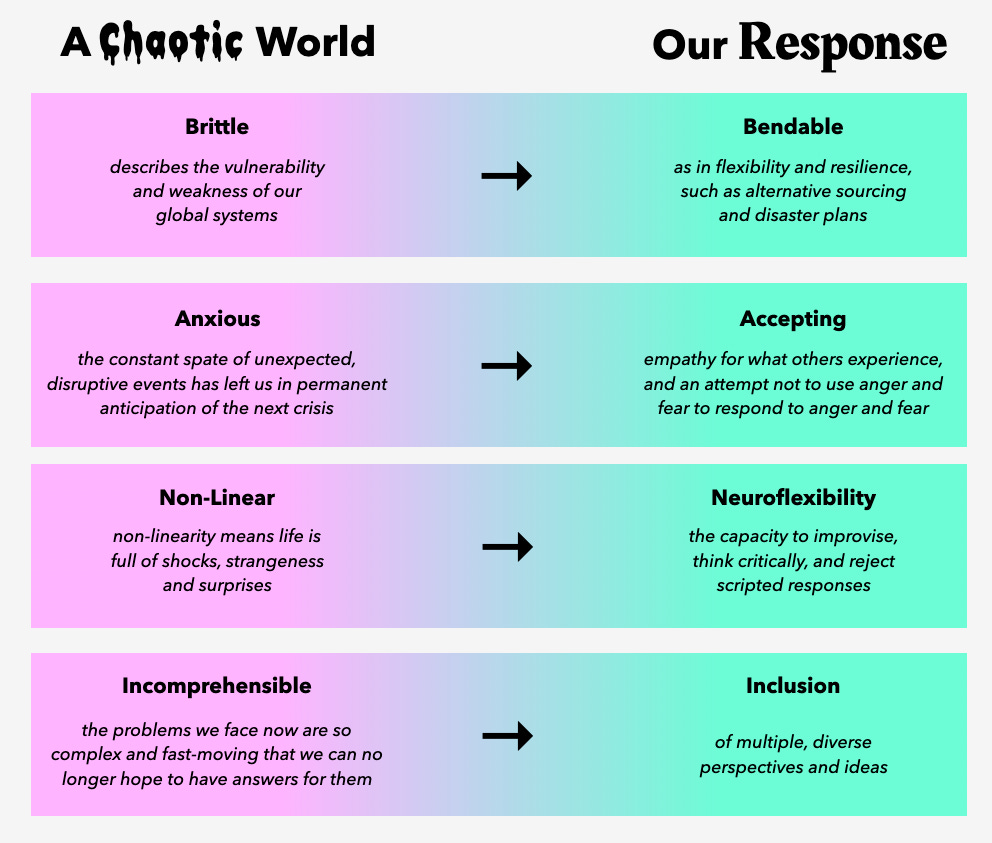
The Positive BANI
🎨 Works
Some hand-picked, particularly thought-provoking work:
TranSense Screen // Nagi Babyboom Town // Gamer in Residence
That’s it for this week’s Rabbit Holes issue!
Did you enjoy this week’s issue? If so, please give it a ❤️ (yes, you can like this e-mail) and share it with your network!
Thanks for supporting my work! 😊