

Rabbit Holes 🕳️ #64
From 200 million years old clothes to coffee shops that all look the same, soulless technology, the filterworld, and websites going offline...sometimes

THIS WEEK → 🦖 Fossil Clothes ☕ Algorithmic Coffee Shops 🌐 Technology Lacks Nature ➕ Filterworld 🚿 Going Offline
Rabbit Holes 🕳️
As always, here are three perspective-shifting ideas to create a better world, plus some extras below. Enjoy!
#1 🦖 Fossil Clothes
I recently had an epiphany about the clothes I’m wearing, specifically about my Patagonia jacket. I looked at it and suddenly realized that I was wearing plastic. Yes, recycled plastic…but still plastic. A vivid image came to my mind of wearing old plastic bags to warm my body in winter – ‘how ridiculous’, I thought. And it made me wanna switch to clothes made out of more “natural” fibers like wool. It’s one thing to know that you are basically wearing plastic. It’s another thing to see or perceive it.
“In the 1980s and 1990s, pre-made food was everywhere because it was quick and easy and convenient. But in the last 10 years or so, we’ve seen this movement of farm-to-table. People started understanding in the wellness space the importance of what we’re eating and how that affects our body. That’s why health food, organic food, and food that was good for the planet became not necessarily fashionable, but definitely more mainstream.
In fashion, we’re stuck in this marketing bubble that presents this glossy idea of fashion. Once it’s in a warehouse or with a brand, it shows up in advertising campaigns or in beautiful content through influencers, celebrities or red carpet dressing. Before that, it’s as if it doesn’t exist. No mention of where it came from. The fashion industry is so dirty that people just don’t want to see it and they don’t want to hear it. And yet, it wasn’t long ago that cloth was deemed as part of the experience of the wealth of the garment or the craft of the garment.
In the face of climate change—and considering fashion’s impact on the climate—what we need to crack wide open and get people to understand is the root of clothes. We need to understand that the silk dress we like was actually a tree not that long ago. When we’re shopping, we need to be asking questions like: Where was the tree from? How old was it? What forest was it part of?
The same goes for fossil fuels, which make up so many of our clothes. Those materials were made pre-dinosaur. And we just extract them and we turn them into plastic or polyester—or we burn them. Usually age means expense, like with precious age stones, gold or wine. Anything that’s been in the ground for that long and we extract is usually deemed valuable. But fossil fuels are turned into cheap clothes that are thrown away after a few wears. These materials were made approximately 200 million years ago, and yet its whole design purpose is either for a piece of packaging; designed to go into a bin. The timeline is totally off. […]
The fashion industry has decided to keep the system dirty and hidden because it’s not in their interest to expose it. Because if they expose it, they need to change it. […]
We need to apply the farm-to-table model to fashion in order to re-engage people with the origin stories of clothes and get them to reconnect. We need to establish a meaningful connection between consumers and their clothes on a mass scale. It must apply to the whole industry. What I’ve learned, though, is that where money and profit are lining the pockets of powerful men, the incentive for them to change is negligible.”
» Atmos | Why Some of Our Clothes Are Over 200 Million Years Old with Amy Powney
#2 ☕ Algorithmic Coffee Shops
It’s interesting to think of your online behavior as a force of globalization and, therefore, homogenization. Your posts, comments, shares, likes, and swipes are basically data points that travel across borders and continents like wind. It’s this data that goes global and gets commoditized to then, eventually, influence culture, business, politics…and, yes, also how we design coffee shops.
“My theory was that all the physical places interconnected by apps had a way of resembling one another. In the case of the cafes, the growth of Instagram gave international cafe owners and baristas a way to follow one another in real time and gradually, via algorithmic recommendations, begin consuming the same kinds of content. One cafe owner’s personal taste would drift toward what the rest of them liked, too, eventually coalescing. On the customer side, Yelp, Foursquare and Google Maps drove people like me – who could also follow the popular coffee aesthetics on Instagram – toward cafes that conformed with what they wanted to see by putting them at the top of searches or highlighting them on a map.
To court the large demographic of customers moulded by the internet, more cafes adopted the aesthetics that already dominated on the platforms. Adapting to the norm wasn’t just following trends but making a business decision, one that the consumers rewarded. When a cafe was visually pleasing enough, customers felt encouraged to post it on their own Instagram in turn as a lifestyle brag, which provided free social media advertising and attracted new customers. Thus the cycle of aesthetic optimisation and homogenisation continued. […]
Though it was particularly identifiable in cafes, the same sensibility could be found in co-working spaces, startup offices, hotels and restaurants – all spaces where time was temporarily spent and cultural taste was flaunted, where physical space was turned into a product. As years passed, however, I came to realise that [this] was less of a specific style than a condition that we existed in, something beyond a single aesthetic trend. […]
We talk about politics, culture and travel becoming globalised, but on a more fundamental level, […] what really flows across the planet are various forms of money and information: investments, corporations, infrastructure, server farms and the combined data of all the digital platforms, sluicing invisibly like wind or ocean currents between nations. We users voluntarily pumped our own information through this system, turning ourselves into flowing commodities, too.
This homogenisation is not just a phenomenon of our own moment; it is a consequence of changes that happened long before algorithmic social media feeds, and is just as likely to intensify in the future. After all, each time a grand flattening is announced the world somehow finds a way to get even flatter.”
» The Guardian | The tyranny of the algorithm: why every coffee shop looks the same by Kyle Chayka
#3 🌐 Technology Lacks Nature
This piece by Douglas Rushkoff ties in perfectly with the two articles (this and that one) I’ve recently written about the “problem” with modern-day technology and the notion that we’ve come to see the world as too “mechanistic”. I particularly liked this expression by Douglas: “We are flying with instruments alone”.
“We seem to be accepting the net [as in internet] as a substitute for that more organic connection we know we have but can’t quite put a metric on. […]
[But] nervous systems and mycelial strands are different from the net. Digital networks can transmit only data, things that can be reduced to some ones and zeros, even if they are reconstituted as music or graphics on the other side of the transmission. When we’re on Facebook, Twitter, or Zoom and FaceTime for that matter, the subtle, physical nature of our exchanges is lost. The aura. Expecting it to be there, expecting the transmission to contain the essential, organic quality of looking into a lover’s eyes, holding a child’s hand, or even just sitting silently in the same room as another person, is not just futile but frustrating. Compassion, as well as the way it metabolizes pain, is decidedly analog.
Our online connectivity is not characterized by the pranic interplay of minds, bodies or souls in a shared dimension, but the exchange of dematerialized symbols passing through nodes. This is why the quality of our exchanges tend toward the ideological, the binary, and the differentiating instead of the spiritual, compassionate, or integrating. Worse, these biases migrate into our offline behavior as well. […]
The disembodied quality of these interactions leaves all of us, at least unconsciously, to yearn for something like grounding. None of us is at home online. There is nowhere to put our feet. We are not natives there, or even here in our own colonial, diasporic, migratory civilization.
When we emphasize the artificially quantized, we lose access to the glorious in-between where we all actually live. […] We lose access to the squishy, indeterminate, and speculative. […] There’s only the ticks of the clock, and none of the duration between them when time actually passes. […] We are flying with instruments alone.”
» Covid Speaks Like ChatGPT by Douglas Rushkoff
➕ Extras
“If you only punish the population and don’t help them have a sustainable income from a sustainable forest . . . what is the way forward?”
Rich world uses green policies to hold back the poor, says UN trade chief by Andy Bounds & Javier Espinoza
“Created by comedian and actor Lisa Beasley, “Corporate Erin” is an iconic character that skewers the inhumane way that institutions can talk to employees with an upbeat voice.”
The 'Corporate Accent' Is Taking Off On TikTok — And It Will Make You Shudder by Monica Torres
“From coffee shops to city grids to TikTok feeds and Netflix homepages the world over, algorithmic recommendations prescribe our experiences. This network of mathematically determined choices - the 'Filterworld' - has taken over, almost unnoticed, as we've grown accustomed to an insipid new normal.”
Filterworld: How Algorithms Flattened Culture by Kyle Chayka (today’s Rabbit Hole #2 is an adapted chapter from this book)
🚿 Shower Thoughts
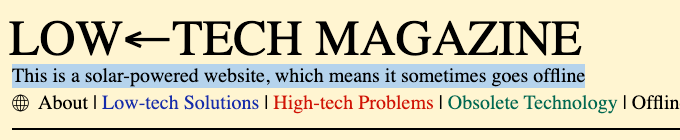
Why aren’t more things “offline” sometimes?
That’s it for this week!
You can support this newsletter by sharing it with your friends and colleagues and thereby help me gain more reach or by ☕️ buying me a coffee.
Thanks for supporting my work! 😊