

Rabbit Holes 🕳️ #175
From being stuck in game theory worlds to the era of impermanence, becoming reverse centaurs, peak social media, default slow, consume → express, a story of life, and when to use (and not) AI

It’s not nostalgia. We’re simply stuck in the past!
The resurgence of flip phones, vinyl records, analog cameras, 90s fashion, mid-century furniture, and the growing desire to resurrect “simpler” times, slower, less digital, more social and local. Across culture and politics, the dominant move isn’t forward anymore. It’s backward. Not because the past was better, but because the future feels unavailable.
So nostalgia isn’t the point itself. It’s a symptom of what I’d call future deprivation.
What do I mean by that? I mean that the future has become increasingly limited, increasingly certain. The plethora of worlds that could be has dimmed down to just a few worlds that might be. Whether that’s the AGI to superintelligence to singularity future, the hyper- or state-capitalism x technofeudalism future, the World War III future, the climate breakdown to apocalypse future, or the future where all of this converges: a cyberpunk-style future.
The thing is, this isn’t an actual closing down of the future. It’s a narrative, story-level one, driven by systems of narrative capture and frame-setting. The idea of the (open) future has been captured, so to speak.
What makes this so heinous is what gets caught in that net: opportunities, solutions, imaginations, and dreams. First, the opportunity space erodes due to path dependencies and system lock-ins. Next, solutions are framed as an threats to the status quo, to “the system”. Then, imaginations are dismissed as unrealistic child's play. And finally, dreams are redirected backwards, into nostalgia.
This becomes so obvious when you dig a little deeper into the solution space, or when there’s occasionally a crack in that future capture and a new framing emerges, when a new voice, idea, or dream briefly gains the spotlight.
This newsletter’s new or slightly updated mission is to highlight that future capture, make it visible by framing it, and then point you toward those cracks that loosen that capture and open up new ways of seeing the world and the future.
This is ultimately an endeavor to unframe the future.
THIS WEEK ↓
🖼️ Framings: Stuck In Game Theory World // The Era of Impermanence // Reverse Centaurs
📊 Numbers: Peak Social Media?
🌀 Re-Framings: Default Fast → Default Slow // Consume → Express // A Futuristic Story → A Story of Life
🧬 Frameworks: When to use (and not use) AI
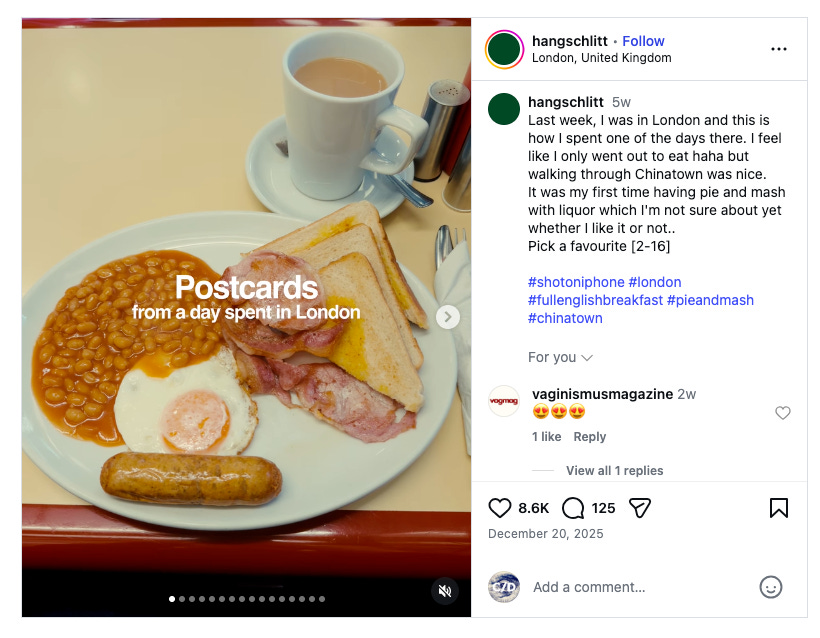
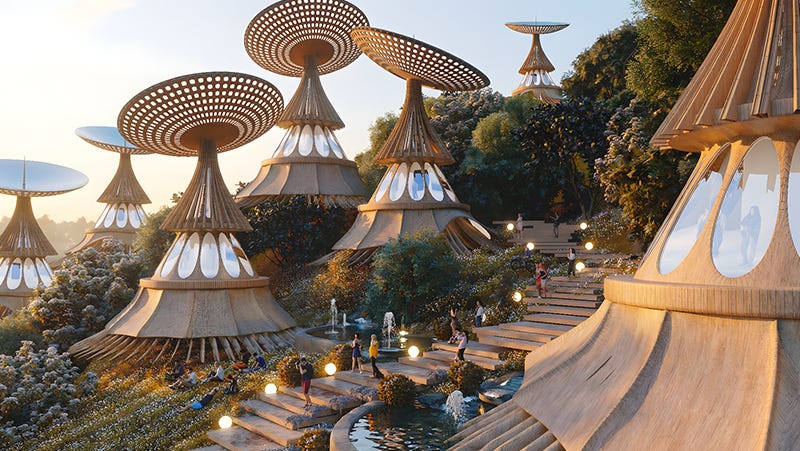
🎨 Works: Mycelium Data Storage // Social Media Postcards // Kinetic Concave Mirrors

⏳ Reading Time: 10 minutes
🖼️ Framings
Naming Framing it! Giving something we all feel more prominence in a way that promotes a deeper reflection.
🃏 Stuck In Game Theory World
Alright…best framing I’ve come across in a long time. I urge you to listen to the entire podcast highlighted in this piece. Once you understand how prevalent game theory thinking is in today’s world, you cannot unsee it. It’s everywhere! And it’s the (!) main thing hindering us from being more cooperative and, therefore, building more cooperative systems and business models.
“Do you know that feeling when you’re playing a game with someone and they start doing things completely out-of-character to win? When someone you trust suddenly stabs you in the back or reneges on a promise? […]
In the context of board games, game mode is (mostly) harmless. But what happens when game mode thinking infects every aspect of our lives? Consider the job market: you tailor your resume to game the algorithms, perform enthusiasm you don’t feel in interviews, and accept that your worth is reduced to whatever makes you most “hireable.” Or dating apps, where you optimize your profile photos and bio and craft messages that follow proven formulas. The list of examples of having to play games in everything we do goes on.
In each case, the incentive is clear: play the game or lose to those who do. […]
Professor Sonja Amadae […] argues that we have become “prisoners” of reason: trapped in a world where optimal strategy and cutthroat competition have crowded out cooperation and trust. […]
Once game theory becomes the dominant logic in a domain, it reshapes that domain entirely. Amadae calls it a kind of “colonization” where authentic human connection gets replaced by strategic calculation.
Dating becomes pickup artistry, where every interaction is optimized for a specific outcome. Software design becomes AB testing, where features are chosen not for human flourishing but for maximum engagement. Political communication becomes focus-grouped messaging, stripped of authenticity and meaning.
“The world kind of feels like it’s being colonized by this cold, strategic logic,” Tristan notes. “What it leads to is this kind of deadening of culture, this deadening of dating, this deadening of relationships, this deadening of software design.”
The problem compounds: once some actors start playing by game theory rules, everyone else feels pressure to follow. The cooperative get out-competed. The authentic get replaced by the calculated. And the world becomes, as Amadae puts it, “a nightmare we can’t wake up from.”
» The World That Game Theory Built by Center for Humane Technology and Josh Lash
🫧 The Era of Impermanence
While we’re living in an inheritocracy when it comes to “normal” levels of wealth. The ultra-wealthy are becoming increasingly “young” and impermanent, which is reflecting on our world. This piece argues that our society’s lack of beauty and the rejection of permanence (and therefore embracing of transcendence) by this “new money” are intimately related.
“In their 2023 work ‘The Missing Billionaires’, Victor Haghani and James White noted that today’s rich are not successful at preserving the one thing you would expect them to be: their wealth.
The ultra-wealthy now emerge into and vanish out of history with astonishing rapidity, leaving little of substance behind. Ours is an era of impermanence. […]
What we build is a reflection of what we believe.
The wealthy are not lazy — indeed, average working hours among elite professions are now longer than they have ever been, and the richest man in the world sleeps on the floor of his office. But the oligarch worldview is that our current age should be transcended. The tech elite believe that our sufferings and sorrows — our limited capabilities and lifespans — can be overcome. Accelerating technological development will save the human condition.
Anything which slows this transcendence down is thus unethical. Design choices which imply permanence, tradition, and ‘weight’ are instinctively rejected. […]
Our society’s lack of beauty and rejection of permanence are intimately related. Influential sociologist E. Digby Baltzell believed that a healthy society is one in which the elite are a balance of new and old money. The existence of new money indicates healthy social mobility — that talent and hard work are rewarded. The existence of old money indicates stability and families who think on generational timescales.
The total dominance of new money — as we have today — is a problem. Though gifted at ‘maximising shareholder value’, such figures make poor leaders in the domains of aesthetics, faith, taste, and culture.
It takes one set of skills to establish financial wealth, but another to create a truly beautiful society. The latter requires a broad, aristocratic, and spiritual education that first generation wealth has rarely received.
Aware of their ignorance, many wealthy figures are too intimidated to patronize art at all.
» Why Did Wealth Stop Building Beautiful Things? by The Culturist
🐎 Reverse Centaurs
We’re increasingly designing technology in a form follows machine approach, where the human is seen as an exploitable resource and where the end goal isn’t augmentation or improvement (qualitatively) of the human skill, but automation and replacement of the human – “the human in the loop” –, entirely. This framing by Cory Doctorow links well with the tools vs. machine framing I presented in AI Reframed, inspired by philosopher Ivan Illich.
“In automation theory, a “centaur” is a person who is assisted by a machine. Driving a car makes you a centaur, and so does using autocomplete.
A reverse centaur is a machine head on a human body, a person who is serving as a squishy meat appendage for an uncaring machine.
For example, an Amazon delivery driver, who sits in a cabin surrounded by AI cameras that monitor the driver’s eyes and take points off if the driver looks in a proscribed direction, and monitors the driver’s mouth because singing is not allowed on the job, and rats the driver out to the boss if they do not make quota.
The driver is in that van because the van cannot drive itself and cannot get a parcel from the curb to your porch. The driver is a peripheral for a van, and the van drives the driver, at superhuman speed, demanding superhuman endurance.
Obviously, it’s nice to be a centaur, and it’s horrible to be a reverse centaur. There are lots of AI tools that are potentially very centaurlike, but my thesis is that these tools are created and funded for the express purpose of creating reverse centaurs, which none of us want to be.”
» AI companies will fail. We can salvage something from the wreckage by Cory Doctorow
📈 Numbers
A thought-provoking chart that perfectly captures a pivotal shift:
Peak Social Media?
….or is everyone just moving over to AI companions?


🌀 Re-Framings
A few short re-framings for building better systems or worlds that I’ve recently come across:
🐌 Default Fast → Default Slow
“It seems that my default consumption speeds for reading and eating (and maybe everything else) reduce the rewards of those things significantly, undermining the point of doing either.
Part of it is my own impatience. But I also suspect that modern living, with its infinite supply of consumables, tends to push our rate-of-intake dials too high. I’m not going to run out of books, or snacks, or opportunities to learn something. There’s always more, so not every crust of bread or printed page needs to be appreciated fully.
Internally though, the mind is juggling like Lucy and Ethel on the conveyor belt at the chocolate factory. Our receptors for meaning and appreciation, like the vacuum head, need more time to do their full work, to make all the connections they’re designed to make.
It might sound like I’m just offering clichés – less is more, stop and smell the roses, take your time – and I guess I am. But clichés suffer the same issue: they are often profound insights, consumed and passed on too rapidly for their real meaning to register anymore. You really should stop and smell roses, as you know if you’re in the habit of doing that. […]
Slowing down your rate of consumption will inevitably change what you want to consume. Reading throwaway news articles or AI slop with great care and attention is only going to show you how empty of value it is. Reading dense writing in inky old books, crafted for your mind by great masters, becomes easier without the rushed pace, and the meaning just blooms out of it. […]
In so much of what we do, we could be getting much more of the part of it that we really seek — but it’s only available at slower speeds.”
» Maybe The Default Settings Are Too High by David Cain
🕺 Consume → Express
“This world is wider than you dare dream, and waiting to show itself to us.
If you pay attention, it will reveal itself in mysterious and miraculous ways. In your subtle senses. In the edges and felt spaces of your knowing. Trust it. Allow yourself to believe it. But don’t stop there.
Apply yourself to expressing it, whether in words or movement or song or paint. Because that effort to express the inexpressible, to create something that illuminates your encounter with the world, can be your ticket to a life of joyful rigour and humility and an alert, alive devotional form of attention.
You will fail, because every attempt fails. The point is not to succeed. It is to change gears. To remember that we are not consumers but co-creators of reality.
That the world itself is a marriage of form and formlessness, the seen and unseen, and that this marriage is presenting itself to each of us in ways that are asking to be expressed; woven into the world to feed the continued unfolding.
Because, no matter what the modern paradigm would have us believe, reality was never merely material. Was never just a bunch of stuff, sitting solid as rock, revealing its full factual truth in the view through a microscope.
The world has always been a work of art, and you have always been an artist.”
» Art is how we fix the consciousness contract by Eleanor Robins
🌸 A Futuristic Story → A Story of Life
“The Space Age didn’t happen because appliances got futuristic. Appliances became futuristic because the country had a future to aim for.
The call organized attention. It organized money. It organized pride and labor. And once the call took hold, the aesthetic poured into everything. Rockets and helmets, yes. But also living rooms, kitchens, chairs, typography, and toys. The story came first. The forms followed. A decade later, we were on the moon.
This is the part I want us to sit with, especially if we care about “new aesthetics.”
Story first. Form second.
Today, I don’t think we lack taste. I think we lack a shared story that doesn’t collapse into cynicism.
Leadership used to mean telling stories that enrolled people into a shared vision. Right now, that muscle feels atrophied. Everyone has a microphone. Almost nobody is building a future that people want to live in. The result is predictable—retreat into nostalgia, into comfort, into the sea of sameness. A world of competent design and timid imagination. We have mistaken legibility for culture, minimalism for maturity, and speed for direction. […]
The deeper question is: what call are we building toward?
If you asked me what call I want, it isn’t “more futuristic.” What the fuck does that even mean? Futuristic is a costume. I want a call that feels like life. […]
Objects that don’t just perform, but belong. Buildings that don’t just impress, but hold us. Interfaces that don’t just convert, but teach people to see again. A future that doesn’t look like a spaceship, but feels like a place worth embodying.
That’s how new aesthetics are born. Not from an announcement. From a refusal, plus a pipeline, plus a call strong enough to pull the world into a different shape.”
» A call for new stories by Paul Jun
🧬 Frameworks
One small, handy framework to build more regenerative, beautiful, and just systems:
When to use (and not use) AI by Alex M H Smith
“AI is useful in some contexts. And positively harmful in others. […]
For closed problems and zoom in thinking, AI is perfect. But open problems? That’s another story. The first issuze is that AI […] cannot get the zoomed out view. The second issue is that even if you use it to support your own thinking, that doesn’t work either because it shifts your brain into “closed problem” mode.
It shuts down your creativity and receptivity without you even realising.”

🎨 Works
Some hand-picked, particularly thought-provoking and inspiring work:

That’s it for this week’s Rabbit Holes issue!
Did you enjoy this week’s issue? If so, share it with one or two friends.
Thanks for supporting my work! 😊
Insightful as always, Thomas. The game theory reframe that changed my worldview was the book Finite and Infinite Games by James Carse. So much better to play infinite games!