

Rabbit Holes 🕳️ #63
From cultivating a slow perspective to embracing uncertainty, AI vibes, why place is important and hoarding bananas in Davos

THIS WEEK → 🐌 Slow Change 🤨 Certain Uncertainty 🤖 AI Vibes ➕ Why Place Is Important 🚿 Hoarding Bananas

Rabbit Holes 🕳️
As always, here are three perspective-shifting ideas to create a better world, plus some fun extras below. Enjoy!
#1 🐌 Slow Change
We are too inundated with mythical stories of sudden breakthroughs, epiphanies, revelations, and wake-up calls. As a result, we’re unable to notice smaller increments of change and are too impatient to see things through. Said differently, change is only perceived as sudden or miraculous (and easy) for those unable to cultivate a slow perspective, a long view.
“We need stories in which getting where you’re going—individually or as a society—mostly happens step by step with maybe some backsliding, muddle, and stalling, not via one great leap. […]
The tree today looks a lot like the tree yesterday, and so does the baby. […]
[But] we are impatient creatures, impatient for the future to arrive and prone to forgetting the past in our urgency to have it all now, and sometimes too impatient to learn the stories of how what is best in our era was made by long, slow campaigns of change. […]
Sometimes seeing it is sudden, because change has been going on all along but you finally recognize it. Maybe you’ve had those moments when […] someone absent for months or years reappears and points out a change to a person or place or system unseen by those who adjusted to without perceiving tiny increments of change that added up. But the change itself wasn’t sudden. […]
Describing the slowness of change is often confused with acceptance of the status quo. It’s really the opposite: an argument that the status quo must be changed, and it will take steadfast commitment to see the job through. It’s not accepting defeat; it’s accepting the terms of possible victory. Distance runners pace themselves; activists and movements often need to do the same, and to learn from the timelines of earlier campaigns to change the world that have succeeded.
To be able to see change is to be able to make change. I’m an advocate for slowness, not in the sense of dragging your feet or delaying your reaction but in the sense of scaling your perception to perceive the events unfolding, because I’m an advocate for making change.”
» Literary Hub | Slow Change Can Be Radical Change by Rebecca Solnit
#2 🤨 Certain Uncertainty
In a society flooded by streams of never-ending information – or instant answers, seemingly… – not knowing or not having an answer is often seen as a weakness. But in an increasingly complex world, uncertainty should actually be considered a key strength – both in terms of actually solving the big challenges we are facing and also in terms of cultivating mental resilience. This line particularly resonated with me: “Life is inherently uncertain, and if you have difficulty dealing with that, you will have difficulty dealing with life.”
“Humans naturally need answers and so typically find uncertainty aversive. With a presidential election, war erupting in multiple zones, rising climate volatility and myriad other types of flux, it’s easy to feel overwhelming angst for the future and see certainty as a beacon in a darkening time.
But a wave of new scientific discoveries reveals that learning to lean into uncertainty in times of rapid change is a promising antidote to mental distress, not a royal road to angst, as many of us assume. A growing body of evidence and a range of new interventions suggest that skillfully managing uncertainty in the face of what’s murky, new or unexpected is an effective treatment for anxiety, a likely path to building resilience and a mark of astute problem-solving ability.
Learning to contend with uncertainty won’t completely fix the problems of our day. But at the start of a new year rife with high-stakes unknowns, we should rethink our outdated notions of not knowing as weakness, and instead discover this mindset as a strength. The implications for taming today’s epidemic distress, divisions and stalemates are vast. […]
Evidence suggests and some leading psychologists believe that uncertainty intolerance is rising. Our devices, with their streams of instant answers, may play a role, as might societal veneration of efficiency.
At heart, being unsure demands a crucial admission: The world is unpredictable, dynamic and flawed — and so are we. It’s an approach that recognizes that the strength of knowledge — and of our own minds — derives from its very mutability. It’s a realm of second chances.”
» New York Times | How to Thrive in an Uncertain World by Maggie Jackson
#3 🤖 AI Vibes
This links very well with my recent post, A Frictionless World Is Boring As F*ck. And while everything is driven by a certain story or narrative, I think it’s becoming clearer that the tech sector, in particular, is more story than anything else these days. And with the current AI hype, we’re just switching over to a new story, a new vibe that’ll continue to boost returns & attention for a few rich people.
“I’ve been trying to make sense of the tech recovery of 2023. It is broader than you would think. The entire sector had a catastrophic 2022. It wasn’t just crypto, Twitter, and Netflix. […] The message, in other words, seemed to be: “digital technology isn’t magic anymore. We’re going to start evaluating big tech companies as though they are companies — on the basis of their expected profits, not their lofty ambitions.”
I’m not surprised that many of these companies rebounded in 2023. But the size of the rebound is shocking. It’s as though the tech crash of 2022 never happened. Like the message of 2023 was: “jk jk, you are magic and special and we just love how you inspire us to dream.” And what makes this especially jarring is that, if we pause to look back at the major headlines that defined 2023’s year in tech… It was not a good year. […]
The sole bright spot was generative AI. Generative AI still has a ton of problems. It remains a revenue sink, not a revenue generator. And OpenAI, which was supposed to be the white knight of the industry, dissolved into weird-nerd-infighting at the end of 2023. And, particularly for the big platforms, the biggest near-term promise made by AI seems to be, “This will cannibalize your main revenue streams, and replace them with something that generates less money for you.”
But what it nonetheless provided for the industry was a sense of futurity. AI is full of futurity.
Futurity ain’t solid. You can’t hold it in your hands. It isn’t liquid either — there’s no money in it, at least not yet. It’s a gas. It fills a room. No one can quite see it, but everyone breathes it in. Or, to lean on the slighly-overused parlance of the day: futurity is a vibe shift.
2023’s AI hype bubble fixed the vibes. Tech companies started to feel like the future again. They started to tell stories about the limitless revenues they would unlock someday. And the big investors liked that talk. And the trading algorithms amplified that too.
This, more than anything else, seems like the underlying point of the AI hype cycle of 2023. Sure, there is a material thing being produced here. And that thing might one day have real value. But investors and executives — the big players with market-shaping power — don’t actually live in the future. They just enjoy LARPing at it. They live in the present. And, in the present, what they require is a big story of potential future profits that can fuel absurd current valuations to sustain all the advantages that come from their extraordinary paper wealth. […]
That’s what sustains the ridiculous valuations. It’s the thing that protects these companies from being judged like normal businesses. Futurity is Silicon Valley’s most valuable asset.”
» The Future, Now and Then | Silicon Valley runs on Futurity by Dave Karpf
➕ Extras
“Aging should be about aging with sass. Spiciness, humor.. a chunk of that about ‘yeah, look at me..’ Wearing your wrinkles as stories. Respect the emotional quotient of years of aging. Tell me about the courage you found when the odds were against you. I want to know about the energy that carried you through the hard times. What you overcame. How you loved. Mourned. How you were changed by life.”
Aging Gracefully Is Boring by Sam Crespi
“I think we’re very near the point where—thanks to the climate crisis—the economy encounters sufficient friction to slow it, and maybe even to send it in a careening spin.”
Friction Is Growing by Bill McKibben
“Whilst the idea of changing global systems can be overwhelming as a challenge in its complexity, there is something altogether more possible in our minds when we consider systemic change from a perspective of place.”
Why Place Is Important To The Emergence Of Regenerative Economies by Jenny Andersson
“Mariana Mazzucato and Rosie Collington show that our economies’ reliance on companies such as McKinsey, Boston Consulting Group, Bain & Company, PwC, Deloitte, KPMG and EY stunts innovation, obfuscates corporate and political accountability and impedes our collective mission of halting climate breakdown.”
The Big Con: How the Consulting Industry Weakens our Businesses, Infantilizes our Governments and Warps our Economies by Mariana Mazzucato & Rosie Collington
🚿 Shower Thoughts
With the World Economic Forum is currently convening in Davos, this one seemed fitting:
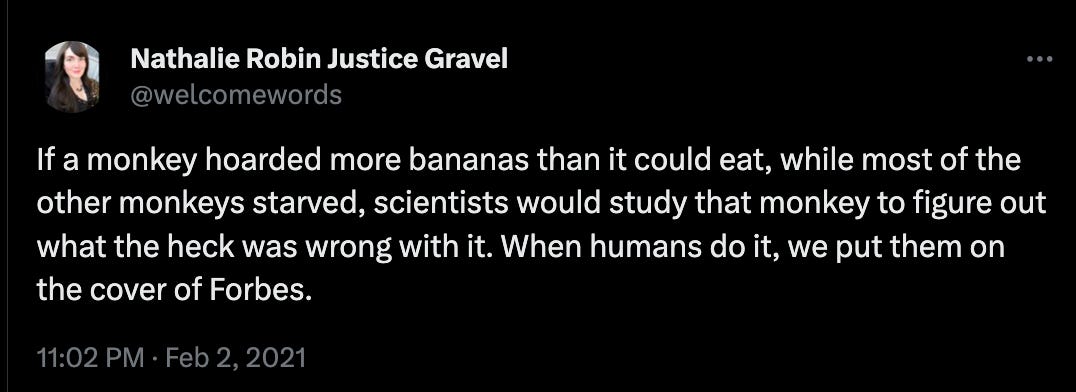
That’s it for this week!
You can support this newsletter by sharing it with your friends and colleagues or by ☕️ buying me a coffee.
Thanks for supporting my work! 😊
Alternative Prosperity: Reframing The "Good Life"

I put this report together because I believe that our current conception of prosperity is breaking down while the need for a new story of prosperity has never been greater. On top of that, existing ideas haven’t really led to the systemic transformation that’s necessary, as they are still rooted in the dominant, destructive narratives of our era.